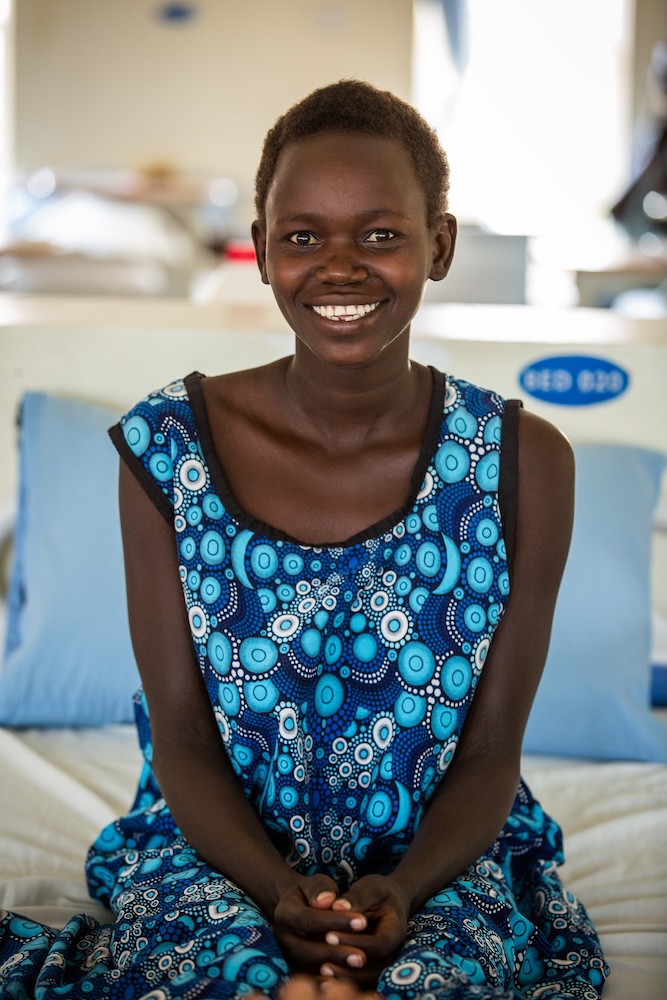
The care Maria needed was hours away.
When Maria went into labor one afternoon, there was no midwife or doctor nearby.
She stayed home through the night, praying her baby could wait until she and her husband could find a way out of their village the next morning.
After traveling two hours to the nearest health center in Kacheri, Maria was told she needed a higher level of care at Kotido General Hospital.
But there was another barrier.
They had no money to get there.
Maria remained in labor for another day while her husband returned home and sold the last of the family’s sorghum to pay for transportation.
Together, they made the three-hour journey to Kotido on a motorcycle.
When Maria finally arrived at the hospital, she was rushed into surgery for an emergency cesarean birth.
But the delay had already taken its toll.
“My baby had died in my womb.”
Loss was followed by another injury.
Maria spent the next four days in the hospital without her husband, who had returned home to bury their baby.
She remembers receiving little direct attention from hospital staff and relying on other people at the hospital for basic help. During the month she remained there, she developed sepsis and experienced malnutrition.
When Maria was finally discharged, another problem became clear.
As her catheter was removed, urine began leaking. The catheter was replaced, and she was told to return in four weeks.
Within a week, Maria was leaking urine continuously. She had the catheter removed at a clinic closer to home, but the leaking did not stop.
Maria was living with obstetric fistula.
Then the isolation began.
The injury affected far more than Maria’s physical health.
Because of the constant leaking and smell, people in her community began avoiding and mocking her. She was given a cruel nickname referring to a woman who urinates while walking.
Her membership in a weekly women’s gathering was revoked.
She was no longer allowed to attend her church.
For months, Maria lived with an injury she did not cause and with the rejection that came with it.
Then one day, she saw a woman walking toward her.
Maria was afraid.
Instead, the woman sat beside her.
“Surprisingly, the lady was so nice to me, and for the first time in four months, a person sat right next to me.”
One survivor became the bridge to treatment.
The woman was a member of the Obstetric Fistula Advocacy and Awareness Network, or OFAAN.
She was also a fistula survivor.
She told Maria about TERREWODE Women’s Community Hospital in Soroti, where women living with fistula could receive treatment and comprehensive support without having to pay for their care.
The advocate called TERREWODE, which arranged transportation for them to Soroti.
For Maria, the welcome she received immediately felt different.
“I was warmly welcomed in my own language, though the person could not speak it fluently. Then I was introduced to another young girl whom they said was going to be my ‘sister friend’ and care for me throughout my hospital stay.”
Healing meant more than surgery.
At TERREWODE Women’s Community Hospital, Maria received care designed around more than repairing the physical injury.
Support covered her preoperative care and fistula surgery, along with physical therapy and counseling during her two-week hospital stay.
She also received economic empowerment training, joined a Fistula Solidarity Group, and had access to additional services intended to support her recovery after treatment.
For a woman who had spent months being pushed away, care also meant being welcomed back into community.
“If only other hospitals would emulate this!”
Maria remains grateful to the people who cared for her and to those who made that care possible.
“I want to wholeheartedly thank the doctors, nurses, and caretakers for treating and taking care of us so well. It’s a very hectic job but these ladies never balk at any patient.”
She also offered thanks to the people working behind the scenes to make treatment accessible.
“I also want to thank those in the office who see to it that money is available for the patients while also paying the doctors and nurses.”
And for the women who helped create the hospital itself, Maria had one more message:
“I do want to shake hands with the women who founded this hospital. May the Almighty God reward them abundantly.”
No woman should have to make this journey alone.
Maria’s story shows how quickly childbirth complications can become something much larger when emergency care is too far away or too expensive to reach.
But it also shows the power of survivor-led outreach.
The person who changed the course of Maria’s story was a woman who had once lived through fistula herself.
She knew what Maria was experiencing.
She knew treatment existed.
And, most importantly, she chose to sit beside her.
That moment helped connect Maria to the care she had been waiting for.