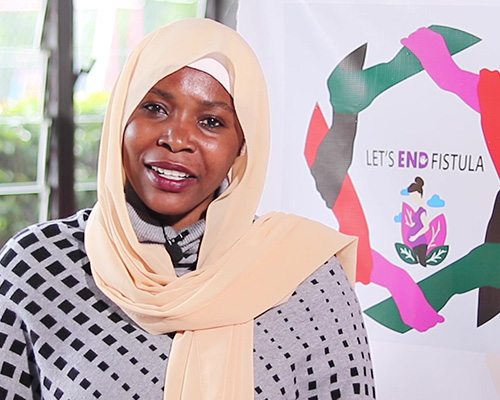
For eight years, Mwajuma lived with an injury that changed how the world treated her.
Today, Mwajuma is a mother, an advocate, and a confident voice for safer motherhood in Kenya.
But her journey there began when she was still a girl.
Mwajuma grew up in a difficult environment with little access to reproductive health information or contraception. At 13, she became sexually active and soon became pregnant.
“I would see other girls of my age engage in sex for commercial purposes. I decided to follow suit in order to meet my needs.”
When it came time to give birth, Mwajuma experienced prolonged, obstructed labor.
The pressure of the baby damaged tissue between her vagina and bladder, creating an obstetric fistula that caused urine to leak uncontrollably.
Her baby did not survive.
Mwajuma survived, but she was left with an injury she would live with for the next eight years.
Fistula changed every part of daily life.
She learned to hide before she learned that treatment existed.
Mwajuma used rags inside her clothing to absorb the constant leaking.
She withdrew from other people to avoid their reactions.
Some people in her village called her a “curse.”
The stigma became almost as painful as the physical injury.
“It was the worst nightmare. My life was full of shame due to the stigma that is attached to fistula. I felt less than a human being.”
For eight years, Mwajuma adapted her life around an injury that was treatable.
Then, in 2008, she finally reached care.
Surgery gave Mwajuma a new beginning.
Treatment opened a door she had once believed was closed.
Through Let’s End Fistula Initiative, or LEFI, Mwajuma received surgery to repair her fistula.
The treatment changed what was possible.
With encouragement from her community and support from LEFI, Mwajuma returned to school.
She later trained as an HIV counselor.
And in 2015, something happened that carried profound meaning after the loss and injury surrounding her first childbirth.
Mwajuma became a mother again.
This time, her baby girl survived.
“I have my bouncing baby girl. She is alive. I’m so happy. I’m so… I lack words how I can explain, but I’m so, so grateful.”
Recovery became possibility.
Mwajuma began building the future fistula had interrupted.
Returning to school was only the beginning.
Mwajuma continued pursuing education and building a life for herself and her daughter.
But she also wanted her experience to mean something for the girls who would come after her.
She knew firsthand what can happen when young people grow up without access to reproductive health information, when pregnancy comes too early, and when skilled maternal care is out of reach.
So Mwajuma became a Safe Motherhood advocate.
The survivor became the teacher.
Mwajuma now uses her own story to help prevent the next fistula.
As a survivor, Mwajuma brings something uniquely powerful to conversations about maternal health.
She does not speak about fistula only as a medical condition.
She knows what it means to live with it.
She knows the isolation.
She knows the relief of treatment.
And she knows how different her own story might have been if she had received the right information and care sooner.
“Fistula is treatable as well as preventable. When we sensitize our communities about safe motherhood, we are not only preventing fistula, but we are also addressing other childbirth-related complications and death.”
For Mwajuma, prevention is deeply personal.
“For me, I find it rewarding if only I can help another young girl not go through the pain and humiliation that I went through.”
Healing can reach the next generation.
Mwajuma’s story did not end when her fistula was repaired.
Treatment allowed her to return to school.
Education helped her build new opportunities.
She became a counselor.
She became a mother to a healthy baby girl.
And her lived experience became something she could use to protect others.
Today, Mwajuma is helping communities understand that fistula is not inevitable.
It can be treated.
It can be prevented.
And women who survive it can become some of the strongest voices for changing what happens next.
Help Survivors Protect the Next Generation
Mwajuma knows what fistula can take from a girl’s life. Today, she uses that experience to make sure other young women have more information, stronger support, and a safer path into motherhood.
Your support helps locally led partners provide treatment today while equipping survivors to become advocates for prevention tomorrow.